
Rectal fever medicine for children is often considered by parents when a child is vomiting, refuses to take medicine, or cannot take medicine by mouth. So, when should rectal medicine be used, and is it better than oral medicine?
Is rectal fever medicine better than oral medicine?
No. If a child can take medicine by mouth, the oral route is generally preferred because it is easier to use and absorption is more predictable.
Rectal medicine may be considered when a child cannot take or cannot keep oral medicine down, such as when vomiting frequently.
Therefore, rectal medicine should not be considered “stronger” or faster-acting than oral medicine.
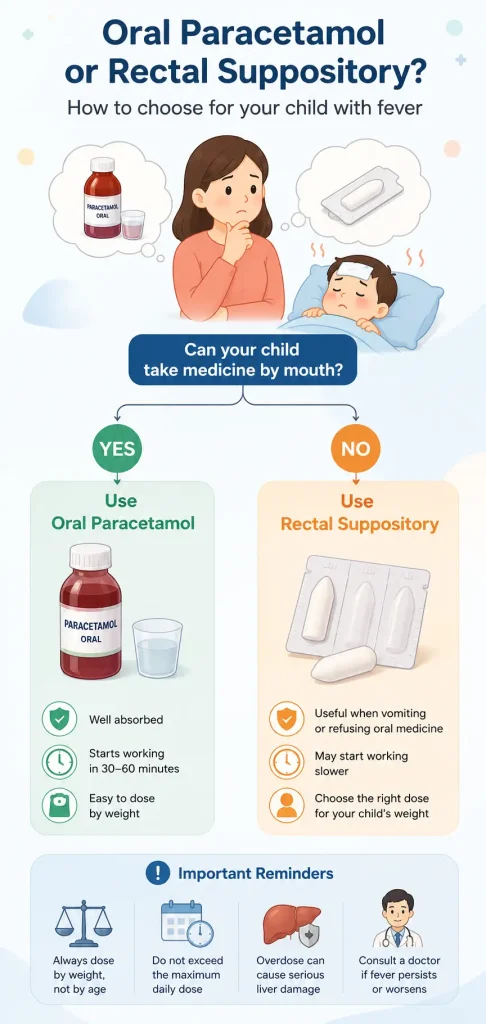
Choosing the route of administration for Paracetamol fever medicine
Can a child who is vomiting use rectal fever medicine?
It may be considered. When a child is vomiting frequently and cannot keep oral medicine down, rectal paracetamol may be an alternative.
However, if the child can still drink fluids and keep oral medicine down, there is usually no need to switch to the rectal route.
If a child is vomiting repeatedly, cannot drink, urinates less than usual, or shows signs of dehydration, parents should seek medical attention rather than simply changing the route of fever medicine.
Does rectal fever medicine need to be dosed by weight?
Yes. The paracetamol dose for children should be based on the child’s weight and the strength of the medicine. A commonly used paracetamol dose is 15 mg/kg per dose, with doses given 4–6 hours apart.
Do not increase the rectal dose on your own because you think medicine is absorbed less effectively through the rectum than by mouth. Some higher doses have been studied in specific clinical situations, but this does not mean they should be used routinely at home.
Parents can read more about fever medicines for children on Bác sĩ bên con.
How long does rectal fever medicine take to work?
Paracetamol usually starts to reduce fever within 30–60 minutes.
If the child’s temperature has not decreased immediately after using the suppository, do not give another dose on your own. The goal of fever medicine is to help the child feel more comfortable, not necessarily to bring the temperature back to normal.
Can a child take additional paracetamol after using a suppository?
Do not give an additional dose without checking first.
If the suppository already contains paracetamol, giving another medicine that also contains paracetamol may result in the child receiving too much of the same active ingredient.
Parents should keep track of the medicine name, strength, and time given to avoid dosing errors.
What if the child has a bowel movement soon after using the suppository?
Do not automatically insert another suppository.
If a child has a bowel movement soon after the suppository is inserted, it is difficult to know exactly how much medicine has already been absorbed. Giving another dose immediately may increase the risk of overdose if some of the previous dose has already been absorbed.
If you are unsure whether another dose is needed, ask a doctor or pharmacist.
Can children under 3 months use rectal fever medicine?
Do not give fever medicine to a child under 3 months without medical advice.
In particular, an infant under 3 months with a temperature of 38°C (100.4°F) or higher should be evaluated by a healthcare professional, as fever at this age may be a sign of a serious infection.
When should rectal medicine be considered?
| Child’s situation | Recommended option |
|---|---|
| Child can take medicine by mouth and is not vomiting | Oral route is preferred |
| Child is vomiting frequently and cannot keep medicine down | Rectal route may be considered |
| Child cannot take medicine by mouth | Rectal route may be considered |
| Child under 3 months with fever | Medical evaluation is needed |
Key points for parents
- Rectal fever medicine is not better than oral medicine.
- The rectal route may be considered when a child cannot take or cannot keep oral medicine down.
- The dose should be based on the child’s weight and the medicine’s strength.
- Do not increase the dose or give another dose too soon.
- Do not give multiple medicines containing paracetamol at the same time.
- Do not automatically repeat the suppository if the child has a bowel movement soon after it is inserted.
Check Your Child’s Fever Medicine Dose
If you are unsure about the appropriate fever medicine dose for your child, you can use FeverCare by Bác sĩ bên con to check fever medicine recommendations based on your child’s weight.
👉 Check Your Child’s Fever Medicine with FeverCare
FeverCare is an informational support tool and does not replace medical examination or a doctor’s advice.
Frequently Asked Questions
Is rectal fever medicine better than oral medicine?
No. When a child can take medicine by mouth, the oral route is generally preferred. Rectal medicine may be considered when a child cannot take or cannot keep oral medicine down.
Can a vomiting child use rectal fever medicine?
It may be considered if the child is vomiting frequently and cannot keep oral medicine down.
Can a child take paracetamol by mouth after using a suppository?
Do not give additional paracetamol without checking first if the suppository also contains paracetamol, as this may result in an excessive dose.
Can children under 3 months use rectal fever medicine on their own?
No. A child under 3 months with a temperature of 38°C (100.4°F) or higher should be evaluated by a healthcare professional.
References
- American Academy of Pediatrics (AAP)
- World Health Organization (WHO)