
Nutrition for babies starting solid foods is not simply about introducing a child to their first foods. It is also a time when children learn how to eat, explore different tastes and textures, and begin receiving important nutrients alongside breast milk or infant formula.
At around 6 months of age, a child’s need for energy and several nutrients begins to increase. At this stage, children need to gradually start eating appropriate, safe, and nutrient-dense complementary foods, while breast milk or infant formula continues to play an important role during the first year of life.
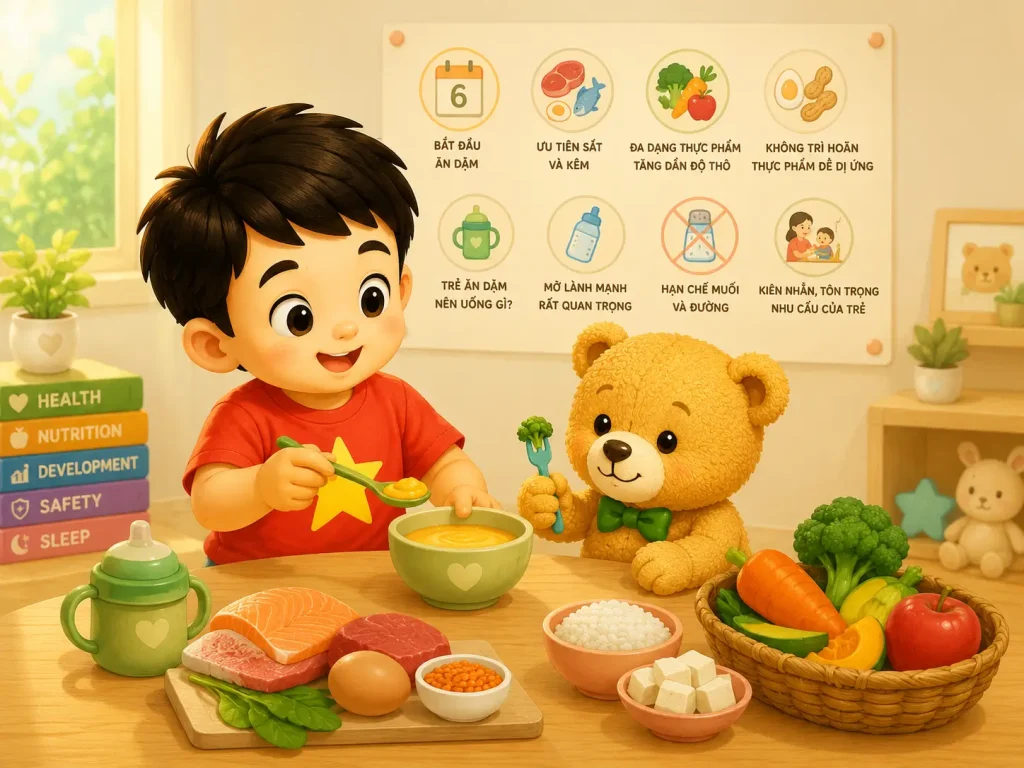
So, what should babies eat and drink when starting solids, and which foods should be avoided? Here are 8 things parents should know to support healthy nutrition during the transition to solid foods.
1. When should babies start eating solid foods?
Most babies should start complementary foods at around 6 months of age, when they show appropriate developmental readiness.
Solid foods should not be introduced before 4 months of age. At the same time, starting complementary foods should not be unnecessarily delayed once a baby is around 6 months old and showing signs of readiness.
Signs that your baby may be ready for solid foods
Parents can look for signs such as:
- Good head and neck control.
- Being able to sit with support.
- Being able to coordinate bringing food to the mouth and swallowing.
- No longer consistently pushing food out with the tongue.
- Showing interest or curiosity when watching others eat.
Starting solids does not mean stopping milk. During the first year of life, breast milk or infant formula remains an important source of nutrition, while complementary foods gradually provide additional energy, protein, vitamins, and minerals needed for growth and development.
2. Prioritize iron- and zinc-rich foods
One of the most important principles of nutrition for babies starting solid foods is ensuring adequate iron and zinc.
At around 6 months, the iron stores that babies accumulated during pregnancy begin to decline significantly. Therefore, introducing iron-rich foods is particularly important, especially for breastfed babies.
Good sources of iron and zinc
Parents can offer age-appropriate foods such as:
- Beef, pork, and poultry.
- Fish and appropriate seafood.
- Eggs.
- Beans and other legumes.
- Iron-fortified infant cereals.
Iron from animal foods, particularly heme iron, is generally absorbed more efficiently than non-heme iron from plant foods.
Parents do not need to wait until a baby is eating large portions before paying attention to iron. Iron-rich foods can be introduced gradually from the early stages of complementary feeding.
3. Offer a variety of foods and gradually increase texture
Starting solids is not only about providing additional energy. It also helps children learn how to eat.
From the beginning, parents should gradually introduce foods from a variety of food groups, including:
- Meat, fish, eggs, and other protein sources.
- Vegetables.
- Fruits.
- Grains and age-appropriate starchy foods.
- Beans and other legumes.
- Healthy fats.
- Age-appropriate dairy products.
There is no need to wait until a baby has mastered one food group before introducing another.
Gradually increase food thickness and texture
At first, foods can be mashed or softened according to the baby’s developmental abilities. As children grow and their chewing and self-feeding skills develop, they should gradually be offered thicker foods and a wider variety of textures.
Keeping foods completely smooth and pureed for too long may limit opportunities for children to practice age-appropriate eating skills.
By around 8 months, most babies can begin exploring appropriately prepared, safe finger foods.
Don’t give up if your baby rejects a new food
Some children need to be exposed to a new food several times before accepting it.
If a baby refuses a vegetable, meat, or other new food the first time, parents do not necessarily need to remove it from the diet. Try again on another day or prepare it in a different age-appropriate way.
Refusing a food once does not mean a child will never like it.
4. There is no need to delay common allergenic foods
Older recommendations sometimes suggested delaying foods that commonly cause allergies. Current evidence does not support delaying foods such as eggs, peanuts, fish, or dairy once a child is developmentally ready for complementary foods.
These foods can be introduced in forms that are appropriate for the child’s age and feeding abilities.
Extra care for babies at higher risk of food allergy
Babies with severe eczema or an existing egg allergy may have a higher risk of peanut allergy. Parents of these children should talk with their healthcare provider before introducing peanut to determine the appropriate timing and approach.
When introducing a new food, particularly a common allergen, start with a small amount and watch for signs of an allergic reaction, such as:
- Hives or a rash.
- Vomiting.
- Diarrhea.
- Swelling of the lips or face.
- Wheezing or difficulty breathing.
If a child develops difficulty breathing, rapidly increasing swelling of the face or tongue, marked lethargy, or other signs of a severe allergic reaction, seek emergency medical care immediately.
5. What should babies drink when starting solids?
During the first year of life, breast milk or infant formula remains an important source of nutrition and fluids.
Once complementary foods are introduced, parents can offer small amounts of water from a cup. There is no need to force a baby to drink a specific amount of water each day if the baby is feeding well and does not have signs of dehydration.
Fruit juice is not necessary
Babies under 12 months of age should not be given fruit juice, including 100% fruit juice.
After 12 months, if juice is offered, it should be limited to approximately 120 mL (4 oz) per day. Whole fruit, prepared in a way that is safe for the child’s developmental stage, is generally a better choice because it provides fiber and helps children learn to eat rather than drink sweet foods.
Avoid sugary and caffeinated drinks
Young children do not need soda, energy drinks, sweetened beverages, sweetened fruit drinks, or caffeinated beverages.
Sugary drinks provide little nutritional value and may encourage children to prefer sweet flavors while displacing nutritious foods, milk, or water.
Cow’s milk before 12 months
Cow’s milk should not be used as the main drink before 12 months of age.
Its nutritional composition is not appropriate as a replacement for breast milk or infant formula during the first year and excessive intake may contribute to iron deficiency.
Age-appropriate dairy foods, such as plain yogurt or pasteurized cheese, can be introduced once a baby has started complementary foods and can safely manage them.
6. Follow your baby’s hunger and fullness cues
Responsive feeding is an important part of healthy nutrition during the transition to solid foods.
Rather than trying to make a child finish a predetermined amount of food, parents should observe their baby’s hunger and fullness cues.
Signs your baby may be hungry
A baby may:
- Open their mouth when food is offered.
- Reach toward or move toward food.
- Show excitement or interest when food is brought near.
Signs your baby may be full
A baby may:
- Close their mouth.
- Turn their head away from food.
- Push food or the spoon away.
- Lose interest in eating.
Parents should encourage eating without forcing the child to eat.
Avoid using food as a reward or punishment, threatening or frightening a child to make them eat, or continuing to feed them after they clearly show signs of fullness.
Mealtimes should also be positive opportunities for interaction. Limit television, phones, and other electronic devices so children can focus on eating and interacting with their caregivers.
7. Prevent choking and practice food safety
Food safety during complementary feeding is not only about choosing healthy foods. Parents also need to pay close attention to food preparation and texture.
Foods that can pose a choking risk
Some foods can cause choking if served in their original form, including:
- Whole nuts.
- Whole grapes.
- Raw carrots or other hard vegetables.
- Hard candies.
- Round slices of sausages or hot dogs.
- Hard, chewy, or otherwise difficult-to-eat pieces of food.
Foods should be prepared to an appropriate softness and size for the child’s developmental abilities, and children should always be supervised while eating.
Children should also eat in an appropriate upright position and should not eat while crawling, running, playing, or lying down.
Do not give honey to children under 12 months
Children under 12 months should not eat honey, whether raw or cooked, because honey can contain Clostridium botulinum spores that may cause infant botulism.
Limit added salt and sugar
There is no need to add sugar to a baby’s food.
Parents should also minimize added salt and foods high in sodium. Young children eat relatively small amounts, yet they have high nutritional needs. Their meals should therefore prioritize nutrient-dense foods rather than added sugars or heavily salted foods.
8. Make every bite count
Young children have small stomachs and may eat relatively small amounts at each meal, while their needs for many nutrients are high compared with their body size.
Therefore, the goal should not simply be to make children eat more, but to make each meal nutrient-dense.
Parents should prioritize:
- Meat, fish, eggs, and other quality protein sources.
- Beans and other legumes.
- A variety of vegetables and fruits.
- Age-appropriate grains and starchy foods.
- Healthy fats.
- Foods rich in iron and zinc.
A child’s diet should not consist mainly of porridge, rice, cereal, or other starchy foods while providing too little protein, healthy fat, or essential micronutrients.
Every small meal is an opportunity to provide nutrients that support healthy growth and development.
How many meals should a baby have each day?
There is no single amount of food that is appropriate for every child. Feeding needs vary depending on age, developmental stage, appetite, activity level, milk intake, and growth.
As a general guide:
- 6–8 months: about 2–3 complementary meals per day, while continuing breastfeeding or appropriate infant formula feeding.
- 9–11 months: about 3–4 meals per day.
- 12–23 months: about 3–4 meals per day, with 1–2 nutritious snacks as needed.
At first, a baby may eat only a few spoonfuls. The amount should gradually increase according to the child’s appetite, abilities, and needs rather than being forced to meet a fixed target.
Foods and drinks to avoid or limit before 12 months
| Food or drink | Important considerations |
|---|---|
| Honey | Avoid completely before 12 months because of the risk of infant botulism |
| Fruit juice | Not recommended before 12 months |
| Cow’s milk as the main drink | Should not replace breast milk or infant formula before 12 months |
| Sugar-sweetened drinks | Not needed and should be avoided |
| Caffeinated drinks | Not appropriate for young children |
| High-sodium foods | Should be limited |
| Foods with added sugars | Should be minimized |
| Choking hazards | Avoid unsafe shapes, sizes, and textures |
Key takeaways about nutrition when starting solid foods
Starting solids is not a competition to see how much a child can eat. Healthy complementary feeding should be age-appropriate, nutrient-dense, varied, safe, and responsive to the child’s hunger and fullness cues.
Parents can remember these 8 principles:
- Start around 6 months, when the child shows signs of developmental readiness.
- Prioritize iron- and zinc-rich foods from the early stages of complementary feeding.
- Offer a variety of foods and gradually increase texture according to the child’s abilities.
- Do not unnecessarily delay common allergenic foods once the child is ready for complementary foods.
- Breast milk or infant formula remains important during the first year; offer water instead of juice and sugary drinks.
- Do not force-feed; respect the child’s hunger and fullness cues.
- Pay close attention to choking hazards, food safety, and foods that should be avoided, such as honey before 12 months.
- Make every meal nutrient-dense, rather than focusing only on how much the child eats.
Every child develops and eats at their own pace. If a child consistently eats very little, frequently vomits during meals, has difficulty swallowing, develops signs of food allergy, or has concerns about weight gain or height growth, parents should consult a healthcare professional for an individual assessment.
If you would like to monitor your child’s growth over time, you can also use GrowthCare – a free child growth tracking tool from Bác sĩ bên con to follow weight, height, and growth patterns.
Frequently Asked Questions About Nutrition When Starting Solid Foods
1. When should babies start eating solid foods?
Most babies should start complementary foods at around 6 months of age, when they show developmental signs of readiness such as good head and neck control, the ability to sit with support, and the ability to coordinate bringing food to the mouth and swallowing. Solid foods should not be introduced before 4 months of age.
2. What foods should babies eat first?
There is no single food that must be introduced first. Parents can choose age-appropriate foods and prioritize iron- and zinc-rich options such as meat, fish, eggs, beans, or iron-fortified infant cereals.
3. Do babies need to drink water when starting solids?
Once complementary foods are introduced, babies can be offered small amounts of water from a cup during meals. During the first year, breast milk or infant formula remains an important source of nutrition and fluids.
4. Can babies under 1 year old drink fruit juice?
No. Babies under 12 months should not be given fruit juice. Whole fruit prepared safely for the child’s developmental stage is a better option because it provides fiber and helps children learn to eat foods rather than drink sweet beverages.
5. When can babies eat eggs and peanuts?
Once a baby is developmentally ready for complementary foods, there is no need to delay common allergenic foods such as eggs or peanuts. For babies with severe eczema or an existing egg allergy, parents should consult a healthcare professional before introducing peanut.
6. Can babies under 1 year old eat honey?
No. Children under 12 months should not eat honey, whether raw or cooked, because of the risk of infant botulism.