
Powder for Oral Suspension in Children is a common dosage form for medicines intended for young children. Before giving the medicine to a child, the powder needs to be reconstituted (mixed with water) according to the manufacturer’s instructions. After reconstitution, the medicine must also be stored under the recommended conditions and used within the specified period.
It is important to note that different medicines may have different reconstitution instructions, storage conditions, and beyond-use periods after reconstitution. Not all powders need to be refrigerated, and not all reconstituted medicines can be used for the same length of time.
This article summarizes the reconstitution instructions, storage conditions, and beyond-use periods after reconstitution for some commonly used oral suspensions in children.
Note: The information below applies to the specific products listed in this article. Products containing the same active ingredient but manufactured under different brand names, strengths, or by different manufacturers may have different reconstitution and storage instructions. Always check the package insert for the specific product being used.
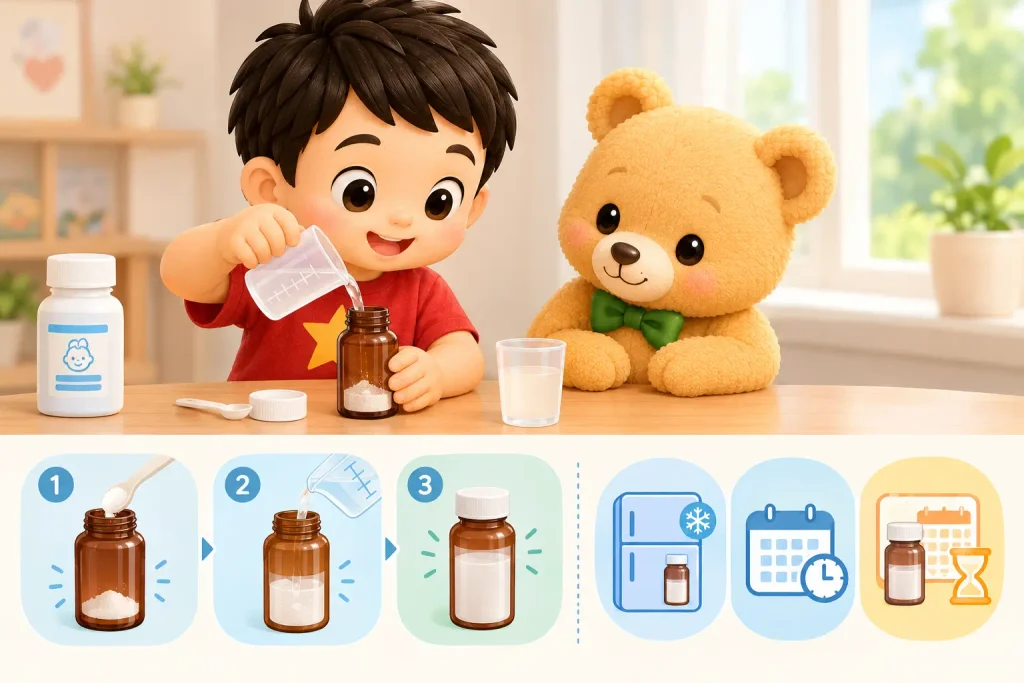
Quick Reference: Powder for Oral Suspension in Children
| Medicine | Active ingredient | How to prepare | Storage after reconstitution | Beyond-use period after reconstitution |
|---|---|---|---|---|
| Augmentin ES | Amoxicillin/clavulanic acid | Add water to the marked line on the bottle | 2–8°C, refrigerated | 10 days when refrigerated |
| Betamox ES | Amoxicillin/clavulanic acid | Add water to the marked line on the bottle | 2–8°C, refrigerated | 10 days when refrigerated |
| Klacid 125 mg/5 mL | Clarithromycin | Add 32 mL of water to the bottle and shake well until the powder is evenly dispersed | Not above 30°C, in a dry, well-ventilated place; do not refrigerate | 14 days at a temperature not above 30°C; do not refrigerate |
| Novafex 100 mg/5 mL | Cefixime | Add water to the marked line on the bottle (37.5 mL) | 2–8°C, refrigerated | 7 days at a temperature not above 30°C |
| Pricefil Cefprozil | Cefprozil | Add water to the marked line on the measuring cup (20 mL) and then transfer it to the bottle, or add water to the marked line on the bottle | 2–8°C, refrigerated | 14 days when refrigerated; 7 days at a temperature below 25°C |
| Taromentin 457 mg/5 mL | Amoxicillin/clavulanic acid | Add water to the marked line on the bottle | 2–8°C, refrigerated | 7 days when refrigerated |
| Zebacef 125 mg/5 mL | Cefdinir | Add water to the marked line on the bottle | Not above 25°C, in a dry, well-ventilated place | 10 days at a temperature not above 25°C |
| Zinnat Suspension 125 | Cefuroxime | Add water to the marked line on the measuring cup (20 mL), then transfer it to the bottle | 2–8°C, refrigerated | 10 days when refrigerated |
| Zitromax 200 mg/5 mL | Azithromycin | Add 9 mL of water to the bottle and shake well until the powder is evenly dispersed | Not above 30°C, in a dry, well-ventilated place | 5 days at a temperature not above 30°C |
For the medicines listed above, before reconstitution, store the medicine at a temperature not above 30°C, in a dry, well-ventilated place and away from direct light, unless the manufacturer provides different storage instructions.
💊 DrugCare – Check How to Prepare and Store Medicines

If you are using a powder or granules that need to be reconstituted into an oral suspension, DrugCare helps you quickly check the preparation method, storage conditions, and beyond-use period after reconstitution for each specific medicine.
👉 Check a medicine with DrugCare

How to Reconstitute Powder for Oral Suspension
The following basic steps can be used when preparing these medicines:
Step 1: Loosen the powder before reconstitution
Gently shake the bottle to loosen and evenly distribute the powder or granules inside.
Not all medicines are prepared in the same way. For products with specific preparation instructions from the manufacturer, follow the instructions provided with that product.
Step 2: Add water according to the product instructions
- Use the type of water and measuring device specified by the manufacturer.
- For medicines with a marked line on the bottle, add water to the specified line.
- For medicines that require a specific volume of water, accurately measure the required amount before adding it to the bottle.
- Some products may require adding water in portions and shaking after each addition. When this is the case, follow the recommended sequence carefully.
- Do not estimate the amount of water using a regular cup or household spoon.
Step 3: Shake well after adding water
Close the bottle tightly and shake well as directed so that the water is evenly distributed throughout the powder and forms a uniform suspension.
For some medicines with a marked line on the bottle, the level of the suspension may appear lower than the original mark after shaking. Only add more water if the manufacturer’s instructions specifically require it. If additional water is needed, add it gradually until the required level is reached, then shake again.
Do not add water based solely on appearance or estimation, because the amount of water used for reconstitution directly affects the concentration of the medicine in each dose.
Step 4: Shake well before each use
After reconstitution, the medicine is usually in the form of a suspension, so some of its components may settle during storage.
Always shake the bottle well before each dose to redistribute the ingredients and help ensure a more uniform amount of medicine in each dose.
Note: The preparation method, amount of water required, and sequence of adding water may differ between products, even when they contain the same active ingredient. Always follow the manufacturer’s instructions for the specific product.
Do All Powder Medicines Need to Be Refrigerated?
No.
This is one of the most common points of confusion when using powder for oral suspension.
Some medicines need to be stored at 2–8°C in a refrigerator after reconstitution, such as Taromentin, Betamox ES, Augmentin ES, Zinnat, and Novafex according to the data in the table above.
Other products should be stored at room temperature after reconstitution. For example, Zitromax 200 mg/5 mL should be stored at a temperature not above 30°C. Klacid 125 mg/5 mL should also be stored at a temperature not above 30°C and should not be refrigerated.
Therefore:
Do not assume that every reconstituted powder medicine needs to be stored in the refrigerator.
Always check the storage instructions for the specific product being used.
How Long Can Reconstituted Powder Medicines Be Used?
The beyond-use period after reconstitution depends on the specific product and its storage conditions.
For the medicines included in this article:
- Taromentin 457 mg/5 mL: 7 days when refrigerated.
- Betamox ES: 10 days when refrigerated.
- Augmentin ES: 10 days when refrigerated.
- Zinnat Suspension 125: 10 days when refrigerated.
- Zitromax 200 mg/5 mL: 5 days at a temperature not above 30°C.
- Klacid 125 mg/5 mL: 14 days at a temperature not above 30°C; do not refrigerate.
- Zebacef 125 mg/5 mL: 10 days at a temperature not above 25°C.
- Pricefil Cefprozil: 14 days when refrigerated; 7 days at a temperature below 25°C.
- Novafex 100 mg/5 mL: 7 days.
Therefore, there is no single beyond-use period that applies to all reconstituted powder medicines.
When reconstituting a medicine, consider recording the date of reconstitution on the label or another clearly visible place on the bottle. This makes it easier to determine when the medicine should no longer be used.
Which Device Should Be Used to Measure the Dose?
Use the measuring device supplied with the medicine or an appropriate dosing device, such as:
- Oral syringe
- Graduated measuring cup
- Medicine dosing spoon
Do not use a regular household spoon to estimate a medicine dose because the size and volume of household spoons can vary.
For young children, an oral syringe generally allows more accurate and convenient measurement, especially when only a small volume needs to be administered.
Important Considerations When Reconstituting and Storing Medicines
1. Check the correct medicine and strength
The same active ingredient may be available under different brand names, strengths, and formulations.
Do not apply the preparation method or beyond-use period of one medicine to another simply because they contain the same active ingredient.
2. Measure the correct amount of water
If the bottle has a marked line, add water to the correct line.
If the medicine requires a specific volume of water, use an appropriate measuring device to measure the volume accurately.
3. Do not change the recommended storage conditions
Not every medicine needs to be refrigerated.
In particular, medicines that are specifically instructed to be stored at room temperature and not refrigerated should not be routinely moved to the refrigerator.
4. Keep the bottle tightly closed after each use
After taking a dose, close the bottle tightly and store the medicine according to the recommended conditions.
5. Shake well before each dose
This is important for suspension medicines because the ingredients may settle during storage. Shaking helps redistribute the medicine before measuring each dose.
6. Do not use the medicine beyond its specified period after reconstitution
Even if some medicine remains in the bottle and there are no obvious visible changes, do not continue using it once the specified beyond-use period has passed.
Frequently Asked Questions
Do powder medicines need to be refrigerated after reconstitution?
Not all of them. Some medicines need to be stored at 2–8°C in a refrigerator, while others should be stored at room temperature. For example, Klacid is specifically recommended by the manufacturer to be stored at room temperature and not refrigerated. Always check the instructions for the specific product.
Can all powder medicines be reconstituted with the same amount of water?
No. The amount of water required depends on the specific medicine and formulation. Do not use the amount of water specified for one medicine to prepare another.
Does the medicine need to be shaken before giving each dose?
Yes. Suspension medicines may settle during storage, so the bottle should be shaken well before each dose.
Can a household spoon be used to measure the dose?
It is not recommended. Use an oral syringe, graduated measuring cup, or dosing spoon with measurement markings, such as the device supplied with the medicine.
Can the medicine still be used after the specified number of days if some remains?
No. The beyond-use period after reconstitution is established based on the stability of the product under specific storage conditions. Once that period has passed, the medicine should not be used.
Can powder medicines be mixed with milk or fruit juice?
No. Powder for oral suspension should be mixed with filtered water or cooled boiled water, according to the manufacturer’s instructions. Do not use milk, fruit juice, or other beverages to mix the medicine, unless specifically instructed by the manufacturer.
Summary
When using powder for oral suspension in children, parents should remember:
Prepare correctly – Store correctly – Use within the specified period – Shake well before each dose.
Most importantly, check the exact medicine name, strength, and instructions for the specific product being used. Do not apply the preparation method, storage conditions, or beyond-use period of another medicine, even if the two medicines contain the same active ingredient.
The information in this article is intended to support the safe and appropriate use of medicines and does not replace the manufacturer’s package insert or advice from a doctor or pharmacist.